Friday, July 24, 2026

Tuesday, March 4, 2025
Saturday, November 30, 2024
A New Novel about Shakespeare's Daughter

All the men of the Shakespeare family died, and most of them died young. Shakespeare himself was only what I consider middle-aged when he breathed his last, in 1616, at 52 -- a late-summer chicken if not a spring one. By then he'd lost his father, his younger brother, and his only son. Neither of his two male grandsons, yet to be born, would see a twenty-fifth year. As for the women, Shakespeare's wife Anne and his elder daughter Susanna both died at age 66, in 1623 and 1649 respectively. Yet there was one Shakespeare child who lived on, from the Elizabethan Age through the Stuart era to the time of Cromwell and the Interregnum, through plagues and witchcraft trials, through the premature deaths of her children and the turmoils and upheavals of the English Civil War, into the first years of the Restoration.
This was Shakespeare's youngest daughter, Judith, who died in 1662 at the age of 77.
You may recall Judith. If you read my 2003 novel My Father Had a Daughter, you know her fictionalized tale -- her grief for a lost twin and her teenage rebellion against her Midlands country life, her flight south to Elizabethan London, the ambitious subterfuge by which she maneuvers her way onto the Globe playhouse stage. This was a Judith imagined and predicated on the slim details of her life conveyed through civil records concerning the Shakespeares. That tale ended with the death of Shakespeare, and Judith's marriage, in 1616.
But Judith didn't. As noted, she lived on, a witness to such staggering transformations both in personal and public life that they call for a continuation of her story.
So I wrote one.
The Owl Was a Baker's Daughter: The Continuing Adventures of Judith Shakespeare was released in book and audio form on February 4, 2025. Too late for Christmas, but in plenty of time for summer reading! If you liked Judith as a young woman, see what you think of her crusty 61-year-old self. Her herbalist skills have grown, and her contempt for pointless social rules hasn't changed, but now that England has turned upside-down, she's a battlefield surgeon with a whole war-torn realm to ride around in. Which she does, all in search of a thing -- perhaps a person -- she long ago lost.
Click to order *The Owl Was a Baker's Daughter* from HarperCollins
Tuesday, May 7, 2024
How Not To Teach Shakespeare to Kids

Monday, May 23, 2022
REALLY Minor Characters in Shakespeare

Let's talk about the minor characters in Shakespeare. I mean the really minor characters, those whose parts are so small, some of them don't even have names. Not that namelessness is necessarily equivalent to minor character status. Hamlet''s Gravedigger has one scene, but he's not a small character. Henry V's "Boy" is not a minor character, nor is the Porter in Macbeth. And then we have the named characters whom we rarely think of when we refer to the plays, but who nevertheless are crucial to the action. As You Like It’s Silvius, Henry IV's Bardolph, and A Midsummer Night's Dream's Peter Quince are major characters. Macbeth's Ross is a secondary character, but one so significant that in Joel Coen's recent adaptation of the play, he takes over the whole script (being outplayed only by Banquo's eyebrows).
So, what characters am I talking about? Ones most people don't even know exist, so microscopic is their presence in the play. Yet, like many trace elements, these characters are catalysts for the action, or for the illumination of some larger character or theme.
Adrian (The Tempest): Okay, Adrian is an exception to all that. He's been called, and is, the most boring character in Shakespeare. This servant of King Alonso exists only to be made fun of by snide Antonio (the hero Prospero's villainous brother) and his sidekick Sebastian in the first scene of act two. That's a purpose, sure, but Antonio and Sebastian already have enough food for mockery in good old Gonzalo, the main butt of their humor in this scene. Adrian is the young "cock'rel," in contrast to Gonzalo, the "old cock," and what he does is say a couple of lines admiring the island landscape and then fall asleep. I include him here only because the degree to which he is a nonentity is remarkable. Perhaps Shakespeare promised somebody a part.
Seyton (Macbeth): Now, Seyton is interesting. Why? Because his name is pronounced "Sa-TAN!" (Picture Dana Carvey saying this as a shrieking Church Lady.) Seyton is Macbeth's servant, but, interestingly, he doesn't show up til act 5, wherein he plays an important role. "Enter Seyton," in response to Macbeth's call: "Sa-TAN!" (OK, he usually doesn't say it like that. But I did once hear an unusually comic Macbeth in Chicago do it this way.) Seyton appears right after Macbeth has resigned himself to the loss of all the things a good king has -- "honor, love, obedience, troops of friends" -- because he's not a good king. At this point Macbeth calls out, "Seyton!," and asks for his armor so he can go out and kill more people. In a subsequent scene, Seyton is the one who plunges Macbeth further into despair -- or dark resignation -- by reporting the death of his wife. And then, having done his devilish job, he disappears. Coen gave Seyton's lines to Ross. But they belong to Seyton.
Emilia (The Winter’s Tale): No, not that Emilia. Not Desdemona's waiting-woman in Othello. That one's a major character. This one is so minor you may never have noticed her. Who is she? A loyal servant of maligned, jailed Queen Hermione; a minor lady who facilitates the more famous and heroic Paulina's errand of mercy to the queen and her newborn daughter. Shakespeare's late plays, among them The Winter's Tale, revisit his tragic plots and change them, making sympathetic characters more powerful, as well as altering the plays' timing so that wounds heal, or tragic actions fail of their effect. In this play, written some six years after Othello, Shakespeare allows this Emilia a power he denied his first one. This one escapes manipulation by a devious husband, outspokenly defends her mistress against the false charge of adultery, and doesn't die in the process.
Cornelius and Voltemand (Hamlet): How strange, that when we already had Rosencrantz and Guildenstern, we also needed Cornelius and Voltemand. Who are they, except for pale reflections of the already sad R & G? Like the more famous pair, these Danish courtiers go everywhere together. (Since a famous modern Cornelius is the ape from Planet of the Apes, it would be interesting and enjoyable to have them played as twin apes.) Voltemand gets all the dialogue. Claudius asks him, "Say, Voltemand, what from our brother Norway?," and gets a 16-line answer: Norway's fine, he's controlling Fortinbras. What is Cornelius for? Why does he even have to be there? He's like the shadow of a shadow of a shadow. And then they're both gone. It seems that there need to be two of everyone in this play. Old Hamlet and Old Fortinbras, Rosencrantz and Guildenstern, two gravediggers, etc. It's like a hall of mirrors. Speaking of character pairs, notice how we start with castle guards Barnardo and Francisco, but then Francisco gets kicked out of the action to be replaced by Marcellus, and from then on Marcellus, Horatio, and Hamlet are the "in" group who gets information about the Ghost. Why don't they trust Francisco? Why does he have a Spanish name? All of this is to say -- sometimes Shakespeare just seems to be messing with us.
The Clown (Othello): Did you know there was a Clown in Othello? There is, he's just not funny at all. In a very weird scene, he shows up to dismiss some musicians whom the depressed and demoted ex-lieutenant Cassio has for some reason hired to play outside the citadel where Desdemona lodges. The Clown puts a stop to it right quick, with a few lewd jokes and insults toward the musicians, whereupon Cassio says, oh, all right, no music. And that's it. The musicians and the Clown exit. Why? I don't even know why I'm including this Clown in this list, except that he has always stuck in my mind ever since I read a very famous Shakespeare scholar's observation about him: "The Clown has no discernible function, and yet the play is not quite the same without him." Someday I'll do a post on the most meaningless comments ever made in Shakespeare criticism.
Old Man (King Lear): Every once in a while you spot an Old Man wandering around a tragedy. There's one in Macbeth. It's good to pay attention to them; they're usually pretty wise. The Old Man in King Lear is not only wise, but kind and helpful, and he's important because he stands for a world of simple good people in the play who might otherwise be obscured by the spectacle of depraved aristocrats. Old Man is kind of like First Servant, who has no name but sacrifices his life in an attempt to keep another old man (Gloucester) from being tortured. Old Man appears in the very next scene to describe himself to now-blind Gloucester as "your tenant, and your father's tenant, / These fourscore years." Like First Servant, Old Man does his best to try to help and solace the wounded Gloucester, and delivers him into caring hands. The world of King Lear is bleak, but not without humanity.
Mouldy (Henry IV, part 2): Some of these micro-characters are great because of the opportunities their dialogue gives the actor. They may not get much to say, but sometimes one line, properly delivered, is worth a thousand, in its ability to express an idea of growing power in the entire play, or in this case, trilogy. Mouldy is one of the poor country yokels impressed by Falstaff to march off to the king's wars. In the first part of Henry IV, Falstaff has callously described these men as "food for powder, food for powder." Here, we see close up the human beings he regards so unfeelingly, collecting only as many "scarecrows" as will fill his muster. Drafting the men, Falstaff makes a joke about this one's name: "Mouldy, it is time you were spent." Mouldy gets a one-word reply: "Spent?" The actor playing him in The Hollow Crown, the recent TV adaptation of the history plays, delivered the syllable magnificently. His disgust and contempt for the proceedings were evident on his face, and he hissed out the word: "Spent?!?" So, that's what a human life is for? To be spent for the power-disputes of our social betters? He even brought a little shamefacedness to the shameless Falstaff (for a moment).
Barnardine (Measure for Measure): Barnardine is a paradox. He's a character who's so funny, he messes up the comedy. In this play's complicated plot, a rather inept disguised duke is trying to manipulate the action so that the heroine Isabella thinks her brother has been executed, but then it will turn out, Surprise, that's not his decapitated head, it belongs to that of the notorious death-sentenced murderer Barnardine! OK, hilarious, but the problem is, Barnardine doesn't feel like getting executed today. "I have been drinking hard all night." He's got a hangover; he's not in the mood. And everyone -- the Duke, the jailer, the judge -- just shrugs his shoulders and goes looking for a pirate or some other lowlife whose head they can chop off instead, which delays the comic action about two scenes. But they do get their head by act five. So funny! Barnardine is instrumental in underscoring how very screwed-up this Viennese culture is, and darkening a comedy to the point of bizarreness. Who said Ionesco invented Absurdism?
Servant Boy (The Taming of
the Shrew): This famous comedy is a play within a play, performed for a drunk who's been pranked into thinking he's watching it with his "wife." His "wife" is a servant youth who's been asked to dress up as a woman for his master's (the prankster's) entertainment. This boy's entire part consists of evading the drunkard's amorous advances and telling him to pay attention to the play. But his role provides an interesting metatheatrical introduction to the fact that all the "women" in the play proper, including, most importantly, Kate the "shrew," are not women at all, but boys dressed up to play women. The marital taming plot emerges finally as a kind of fantasy, largely thanks to this transvestite boy.
William (The Merry Wives of Windsor): This William is the son of one of the play's two heroines, and he plays a very minor role in the action, but we should take note of him because of his name. William Shakespeare never met a pun he didn't like, and one of his favorite puns was the word "will," which could mean all kinds of things, including bawdy things, but in this case seems to mean, "childhood version of myself who struggled with Latin." The first scene of the fourth act of this play "pauses" the action for a sustained dialogue in which young William is quizzed in Latin, and every one of his answers, right or wrong, is an occasion for a dirty joke. This, it seems, is how schoolboy Shakespeare and his friends got through their Latin lessons. Some schoolboys never entirely grow up.
'Til next time.
Tuesday, February 1, 2022
More on Othello and Blackface
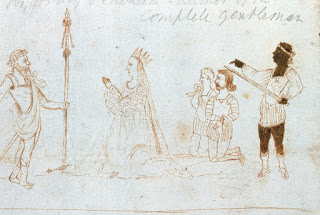
This is not just to acknowledge that in 1604, all Shakespeare's characters, and those of his rivals, were played by male whites, except for the characters in elaborate masques written and staged in private palaces for the aristocracy, in which women sometimes took part. (The women were also white, of course. Ben Jonson's Masque of Blackness is an interesting example of a play written to be performed by women in blackface.) It's a given that the Elizabethan and Jacobean theatrical world was not a racially diverse milieux, although it's not impossible that of the hundred or so black Londoners of the early seventeenth century, one or
Saturday, January 1, 2022
"Speak of me as I am": Shakespeare and the New Orthodoxy
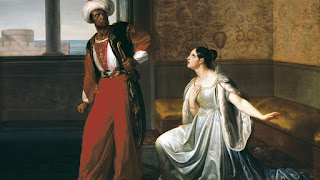
Well . . . maybe that wasn't the "end" result. Since this incident was first reported in a university newspaper article entirely sympathetic with the aggrieved students' viewpoint, over 700 Michigan faculty and students have written in protest against
Wednesday, December 1, 2021
Duping Facebook with Shakespeare

Last week, when I asked my students why, during a discussion of Macbeth, they were using the awkward non-verb “to un-alive” to describe the action of regicide, they informed me that Facebook had trained them to it, with its flagging of the word “to kill.” “People,” I said. “This is Shakespeare seminar. We can do better than that.” Shakespeare offers us myriad terms to describe deading a person. Here are just a few: to “murther,” to cause to “dwell in solemn shades of endless night,” to send to the “undiscovered country from whose bourn no traveler returns,” to “unseam,” to render a “tongue . . . a stringless instrument,” to make one’s antagonist “food for worms.” The list goes on.
Later I went to Google to inquire about other Facebook-flagged
words. A post from last year on HVMA Social Media warns advertisers that
Facebook seeks “generally uplifting, growth-oriented content!,” and cautions that “using ad copy which directly speaks on weight, health, beauty,
anxiety, loss, failure, underachieving, or other such negative self-implicating
topics are almost always negated from the platform.” This type of thing poses
communicative challenges which Shakespeare can help overcome.
References to weight: Here the Henry IV plays are useful. Shakespeare does not
Monday, November 1, 2021
Huck's Shakespearean Soliloquy

As is well known, Mark Twain's Huckleberry Finn chronicles the peripatetic journey of the boy Huck and his friend, the runaway slave Jim, as they make their way mostly by raft down the Mississippi River. At one point in the tale, Huck, brought up according to a white supremacist ideology that sanctions slavery as part of the natural order, must decide whether to betray Jim to his former owner, as his conscience bids him, or to continue assisting Jim's pursuit of freedom, as some deeper, contrary instinct tells him to do. Corrupted by church and Southern culture's belief that to assist a slave's escape is thievery, and that anyone who does so "goes to everlasting fire," Huck tries to pray "to quit being the kind of boy that I was" -- that low-down type who would help a slave escape -- "and be better."
"So I kneeled down. But the words wouldn't come. Why wouldn't they? It warn't no use to try and hide it from Him. Nor from me, neither. I knowed very well why they wouldn't come. It was because my heart warn't right; it was because I warn't
Friday, October 1, 2021
MACBETH Time

There is really only one appropriate season to teach Macbeth. Ideally, discussions and, if possible, expeditions to see this play should fall between mid-October and the end of the first week in November, because, of course, not only Halloween but All Souls' Day (November 2) and Guy Fawkes Day (November 5) are at stake. All these holidays -- as we find in Mexico's Dia de Muertos -- share Macbeth's grisly but humorous tone and atmosphere. Borges thought the play cast an unrelievedly nightmarish pall over the playgoer's senses, but, with due respect to that great Argentine author and Shakespearean, Macbeth's nightmare is not totally dark. The play is in fact punctuated by the humor of the gallows. The phrase is apt. Macbeth contains references to the Gunpowder
Monday, July 5, 2021
Shakespeare, Live Performance, and Regendering Roles

Yesterday I heard part of a discussion on NPR, concerning the current reopening of theaters as well as other ticketed events in the wake of Covid. (I wish we were in the wake of Covid; I'm speaking hopefully.) Although most of this discussion was related to the ways people are being ripped off by scalpers, the program host began by posing a different question to the radio audience: what was the last live performance you saw before Covid shut us all down?
It's interesting how easy it is to answer a question like that. It's like -- on a more or at least differently tragic scale -- the question of where you were when you heard President Kennedy had been shot. If you were five or over, you remember. (I was five, and I remember.) You remember what you were doing before a completely unexpected thing descended and instantaneously changed your world in a way you did not like. Quite likely you were doing something you enjoyed, but that kind of enjoyment was going to depart for a while. (Yes, in November 1963, this was true even for kindergartners, because we lived in families which contained adults who understood things better than we did.) But this is too grim! I didn't mean to go there. I just want to say that I do remember the last live performance I saw before Covid hit, as do the people with whom I attended it, and we all looked back on it with a kind of appreciation that we had taken the trouble to go to it, since we weren't going to be able to see anything else like it for a very long time. Of course, this being a Shakespeare-ish blog, it will not surprise readers to know that the performance was a production of a Shakespeare play.
The work was Timon of Athens, a weird and melancholy play caught somewhere between the genres of tragedy and satire, like several others Shakespeare wrote in the first decade of the seventeenth century (e.g., Troilus and Cressida). It was directed by Simon Godwin of the Shakespeare Theatre of Washington, D.C., where I grew up (in the D.C. area, not inside the theater) and which I was visiting. Despite this theater's annoying habit of spelling "theater" with its "e" on the end as though we weren't Americans (Chicago Shakespeare Theater doesn't do that, by the way), I have never seen a play performed by the group that wasn't made spectacular by their acting. As a teenager whose mom held season tickets, I was lucky enough to see, not once but many times, luminaries such as the magnificent comic actor Floyd King (an unforgettable Don Armado), Franchelle Dorn (hilarious as Mistress Page in Merry Wives), and Edward Gero (in so many roles, but most recently as the tortured ailing monarch Henry IV in the second part of that play).
But this time, in March of 2020 -- truly right before it all shut down -- my friends and I were watching, in the lead role of this lesser-known Shakespeare play, a British import, Kathryn Hunter of the Royal Shakespeare Company. She was the main reason I'd wanted to go. Ever since I saw, on film, her extraordinary rendition of Puck in Julie Taymor's 2014 version of A Midsummer Night's Dream at the Theatre for a New Audience (oh, that final "e"), I had wished to see her again, in something! As Puck, the diminutive Hunter, though already in her 60s, exhibited the flexibility and gymnastic skills of an Olympic gymnast. She performed in a Charlie Chaplinish "Little Tramp" type outfit, and her voice, strange and gravelly, added to her boyish androgyny, as she crouched like a frog and scuttled like a crab across the stage, or allowed herself to be lowered head down from the rafters by means of her expanding elastic pants. (That Julie Taymor!) Still, I wouldn't have guessed the next Shakespeare role I'd see her in would also be a male one. Yet so it was.
Puck, like The Tempest's Ariel, is often played by women. As spirits, both seem somehow genderless. Timon, the savage, misogynistic, and very human hero of Timon of Athens, is different, which, I assume, is why Simon Godwin (if it was he; Hunter first starred as Timon with the RSC) simply made the character female -- a wealthy lady of ancient Athens, rather than a lord, however historically unrealistic that choice may have been. (It certainly isn't the only historically weird thing about the play, as is usual in Shakespeare. For example, Timon, an Athenian who lives centuries before Christ, spouts some terminology proper to the Christian religion, in references to church "canons" and "cherubim.") In general I'm a traditionalist who is skeptical about the contemporary craze for women playing male Shakespeare roles, but in particular cases I usually forget such distinctions immediately when the acting is good, and . . . this was Kathryn Hunter. Spectacularly, she rode the roller coaster from the first three acts of the play, where the spendthrift Timon feasts his friends on credit, to the final two acts, wherein Timon, after being rebuffed when he visits those same friends to beg loans, retires to the wilderness as a misanthrope, to curse thankless mankind. Hunter was clad in a gold gown and headdress for the first three acts, serving her friends in a gold-draped dining room on plates and platters of gold, which, when confronted with the evidence of their ingratitude, she throws at them (in one of my favorite scenes in Shakespeare). This tiny Timon went berserk! And her throwing arm was magnificent. But in the final acts, crouching half-wild in rags to deliver her great maledictions against mankind, Hunter outdid herself, preaching a savage indictment of money and those who lie, cheat, steal, and kill to possess it. "Gold" is a "yellow slave" that will "knit and break religions," "place thieves and give them title"; it's "the common whore of mankind." Delivering these lines, Hunter, mud-besmirched and crouching, simian-like, close to the earth, seemed a demonic version of the Puck she'd once played -- or perhaps a harbinger of Caliban, whom I'd love to see her enact one day.
For its excellence, her performance would have burned itself into my brain no matter when I'd seen it. But there was something particularly memorable about the timing, with the play opening in Washington a few weeks before the coming of Covid, which of course cut the run short, and in the year of the U.S. presidential election, which so bitterly divided and continues to divide our nation. "The middle of humanity thou never knewest, but the extremity of both ends," Timon is told. In his person, he demonstrates the failure to find Aristotle's moderate mean of human behavior, choosing extravagance and then misanthropy, never achieving simple generosity. In the midst of our extremism and identity politics, in our world of victims and perpetrators, it was worthwhile to go into the sad season with a memory of this representation of human folly. Shakespeare's deluded protagonist first thinks everyone is noble, and then, when he gets disappointed, concludes people are all monsters. He never finds the middle, the place Jesse Jackson used to call "common ground." Humor, humility, acceptance of human imperfection, and the ability to listen -- Timon has none of it, though his play contains no lack of characters to point out what's missing. In the early months of 2020, I'm glad I was there to hear it.
Tuesday, June 1, 2021
Consider These Lines

People who don't read or see a lot of Shakespeare -- in other words, most people -- naturally don't understand why they should. What's in Shakespeare for them? They may well ask, since Shakespeare is far more often pointed to -- "Look! Greatest English writer!" -- than discussed in a way which might cast light on why he is known as the greatest English writer. (Unless, like me, you're a Shakespeare nerd who speaks with other Shakespeare nerds. But we're a small slice of the global population.)
Going to a really well performed Shakespeare play provides its own answer to the "why" question. As a playgoer, you don't have to have read any Shakespeare before, to be struck by the beauty and insightfulness of Shakespeare's dialogue. You may not understand all of it. But you'll understand a lot of it, and the part you understand will be unlike anything you've heard before. Shakespeare takes on all subjects, all fundamental human experiences, sees them from the inside out, and articulates them with bone-chilling precision. What is that worth? If a central purpose of literature -- including dramatic dialogue -- is to hold a mirror up to human nature, to show us who we are (as Hamlet says), then Shakespeare succeeds. And if one purpose of that action is to make us feel recognized and known, he gives us that, too.
Because I have nothing better to write about today, I will offer two examples, from speeches which, set against each other, express diametrically opposed but universally recognizable human experiences. The person who wrote these speeches knew what he was describing, and he knew how to describe it.
First: apathy, listlessness, depression. Anybody feel that way these days? Has anyone felt these things over the past year? Hamlet is your spokesperson. In acts one and two, he's depressed, and he's depressed about the fact that he's depressed. ("Melancholy" would be his word.) What interests him? Nothing. What used to interest him? Everything. We think of Hamlet's goal as finding and punishing his father's murderer. It is, but his underlying goal is recovering the self he has lost. Ophelia, too, wonders where he's gone: "O, what a noble mind is here o'erthrown!" But Hamlet wondered first. Here are lines from his first soliloquy:
O, that this too too sullied flesh would melt,
Thaw, and resolve itself into a dew!
Or that the Everlasting had not fixed his canon
'Gainst self-slaughter!
This is definitely suicidal thought. But the lines communicate the widely recognizable, garden-variety suicidal thinking of one who is finding relief in fantasizing about suicide because he lacks the energy to off himself, even though he finds life worse than a drag. Like Keats (doubtless inspired by this speech), who wished, in "To a Nightingale," "to cease upon the midnight with no pain," Hamlet doesn't want to take the initiative for such a choice. He just wants to melt into a goodbye (an "adieu." He's still got enough energy for a smattering of wordplay). He next claims that all that's stopping him is God's edict against "self-slaughter," with another little pun on the "fixed canon," which is both a rigid restrictive rule and a weapon aimed at that rule's violation. But Hamlet is full of reasons not to do things. This is his first. He's apathetic, listless, and unhappy, and nothing delights him. He says it best: "How weary, stale, flat, and uprofitable / Seem to me all the uses [customs] of this world!" No spark of interest resides in anything. It's all stale. Flat. Weary. Useless. He wasn't always like this; he doesn't know why he's like this now. He later tells Rosencrantz and Guildenstern, "I have of late -- but wherefore I know not -- lost all my mirth . . . and indeed it goes so heavily with my disposition that this goodly frame, the earth, seems to me a sterile promontory." Surprisingly, these sour lines are the lead-in to the famous exclamation, "What a piece of work is a man!," which, extracted from context, sounds exalted and appreciative. It isn't. Hamlet follows that line with, "And yet, to me, what is this quintessence of dust? Man delights not me." It's all not only dust, it's absolute, concentrated dust.
Yes, he's depressed, and he knows how to say so. In other words, Shakespeare understood depression -- the most enervated version of melancholy -- and knew how to remember and describe it.
But Shakespeare also understood joy.
Many excellent expressions of joy exist in Shakespeare, but one of the best is found in The Merchant of Venice, in lines spoken by young Bassanio, once it is confirmed that he has won the fairytale-like "casket test" which gives him the right to marry Portia, whom (maybe) he loves. He says he is too joyful to speak, although, of course, being a Shakespeare character, he still can, and in blank verse, too. He compares his (alleged) confused inarticulateness to the competing voices of a happy crowd which, "blent together / Turns to a wild of nothing save of joy / Expressed and not expressed." A wild of nothing, save of joy. All words unintelligible, canceling each other out, but the sound of happiness still audible. This is the paradox of joy unspoken, but still, somehow, spoken. So, whereas Hamlet has no joy, and many words ("Words, words, words" he drones), Bassanio has no words, and transcendent joy.
Countless shades of human experience reside between these two extremes. I would bet that many of them are inchoate, sensed but not clearly seen, until precisely described. Most people, even the wordiest, lack that level of precision. Where Shakespeare found it, what supplied him with that talent, is a mystery of the ages . . . .
Saturday, May 1, 2021
Horrid Speech Shakespeare Would Never Use

It's May, and time for my latest list of horrible non-Shakespearean journalistic or advertising or other sorts of contemporary sayings, along with suggested Shakespearean substitutes. Here are ten.
1. Headlines like this: "Benedict Cumberbatch's Sweet Valentine's Day Wedding: Everything You Need To Know." Here's what I need to know about Benedict Cumberbatch's sweet Valentine's Day wedding: Nothing. NO THING. Benedict Cumberbatch is an actor. I like seeing him on the screen. I don't give a flying fig about his personal life. What would Shakespeare say about this headline? He'd have Ophelia sing, "Tomorrow is Saint Valentine's day," and then thank Bonafide Cummerbund for helping keep Hamlet alive on stage (at least until act five, scene two) four hundred years after Shakespeare himself departed for the undiscovered country from whose bourn no traveler may return.
2. "Bespoke" and "hand-crafted." These are disgusting terms that should be eliminated from the English vocabulary. There's no space to list the ways in which
Friday, April 2, 2021
Shakespeare's Spaniards

Often people make much of the fact that many of Shakespeare's comedies are set in Italy, a convention of early-modern English comedies which derives largely from Tudor playwrights' important models, the works of the first-century Roman playwrights Plautus and Terence. In plays like The Two Gentlemen of Verona, Romeo and Juliet, or The Taming of the Shrew, you won't find much evidence that Shakespeare knew many actual Italians, or, much less, had ever visited Italy, despite all his Hortensios and Petruccios and Benvolios. Usually his "Italian" characters seem like English folk (though this is not always the case: in England, Italians had a reputation for
Monday, March 1, 2021
Shakespeare, Jonson, Plague

Last year at this time, I wouldn't have dreamt we'd be walking around with masks on our faces in March of 2021. I remember trying to buy some dust masks at the hardware store back then, thinking they might be useful over the next few weeks. (They were already sold out.) A month after that, when I wrote this post, I would have been equally surprised to hear that it would still be relevant, or even understandable, in 2021. But it is. So I'm posting it again: a look back to how things seemed, Shakespeare-wise, Ben Jonson-wise, and Covid-wise, a year ago.
I hope I'm not posting this a third time in 2022.
April, 2020. This month, in our time of modern-day plague, I shall not write yet one more claim that Shakespeare wrote King Lear or Macbeth while quarantined for the "pest," as they called it. (He did not.) Instead, I am offering my parody of a poem by Shakespeare's greatest rival, his brilliant contemporary, the playwright and poet Ben Jonson (pictured left of Will), who inhabited the early modern theater world alongside Shakespeare and enjoyed insulting him from his bully pulpit of the stage. All evidence suggests that Jonson and Shakespeare were friends, though they
Monday, February 1, 2021
Shakespeare in Winter

It's gray and cold and snowy in Michigan, and whatever the Groundhog does tomorrow, it's likely to stay this way til at least the middle of March. The weather puts me in mind of Shakespeare's descriptions of winter.
Seasonal change is a fundamental metaphor in Shakespeare's poetry. He is fond of the coming of spring. Who isn't? "From you I have been absent in the spring," the poet laments in one sonnet. The Winter's Tale, despite its title, is popping with references to budding flowers and greenery, and its longest scene features a springtime sheep-shearing festival. Twelfth Night takes its title from the Eve of Epiphany, in the first week of January, but its characters, too, spend much time frolicking outside, presumably in mild climes and a gentler time of year. Where, then -- outside of a couple of titles -- is winter in Shakespeare?
We can find it here and there. Here's a verse from the song that concludes Love's
Friday, January 1, 2021
Ten Things Shakespeare Wouldn't Say if He Were Alive in 2021

I've got ten new things people say that I want them to stop saying. The people I have in mind are advertisers, news commentators, politicians, and university administrators. They are not like you and me. They speak their own language, one I know Shakespeare would have disdained, and there are certain current terms on the hearing of which I know he is spinning in his never-to-be-violated grave. Therefore, Shakespeare and I mutually request that these folks find substitutes. Drawing on Shakespeare's own rich vocabulary, I will recommend some, following this list of Terms Which I Request Be Left Behind with the Rest of the Miserable Year 2020.
1. "Gift" instead of "give," as in, "Gift one, get one free." Yes, I know Shakespeare liked to turn nouns into verbs. Who can forget "Uncle me no uncles,"
Tuesday, December 1, 2020
Shakespeare and Christmas

Sunday, November 1, 2020
Banishing Trump-staff

Wednesday, September 30, 2020
Friendship or Fear
 Shakespeare's history plays offer us case studies contrasting different kinds of leaders. Mostly these leaders are medieval monarchs, whose modes of governance and levels of power differ hugely from those of contemporary heads of state (or would-be heads of state). But we wouldn't still be staging, watching, and reading Shakespeare if we didn't see ourselves in his characters, and our culture in his culture, as in a distant mirror (to adapt the famous phrase of the medievalist historian Barbara Tuchman).
And so, as I prepare to teach Shakespeare's Richard III to a group of undergraduates for perhaps the thirtieth time, I newly notice aspects of the play that speak to, and seem to speak of, the politicians among us, vying for power in this third decade of our twenty-first century. What I'm noticing this time is the two very different speeches given by two rival leaders in the fifth act of Shakespeare's play.
The first speaker is Henry, Earl of Richmond, soon to be crowned Henry VII, the first Tudor king. The second is Richard III, the Yorkist usurper who is defending his throne. In Shakespeare's play, Richard is the villain and Henry is the hero, in two-dimensional characterizations that ignore much of actual history. Shakespeare